
Financial stocks have not been immune to the recent volatility in markets stemming from questions over the AI trade and higher oil prices. European banks in particular have had to contend with the sell-off in government bonds and rising political risk in France. Yet the recent conference season has provided us with an excellent opportunity to catch up with the management teams of many European as well as a couple of US financial companies across the sector and the feedback has been consistently constructive.
European banks
The Trust favours European banks for their lower valuations, improving returns on equity and potential for consolidation. The portfolio holds banks from across the region, with no exposure to France. Recent market falls have left the Euro STOXX Banks Index around 14% below its highs. Total returns for the index are still up 5% year to date in sterling (+9% in euro terms), but the sector trades on 9.0x 2027e price-to-earnings ratio (P/E), a 35% discount to the broader market. That is materially wider than the historic average despite banks being now better positioned on profitability, balance sheet strength, and regulatory clarity.
| European banks trading at a discount |
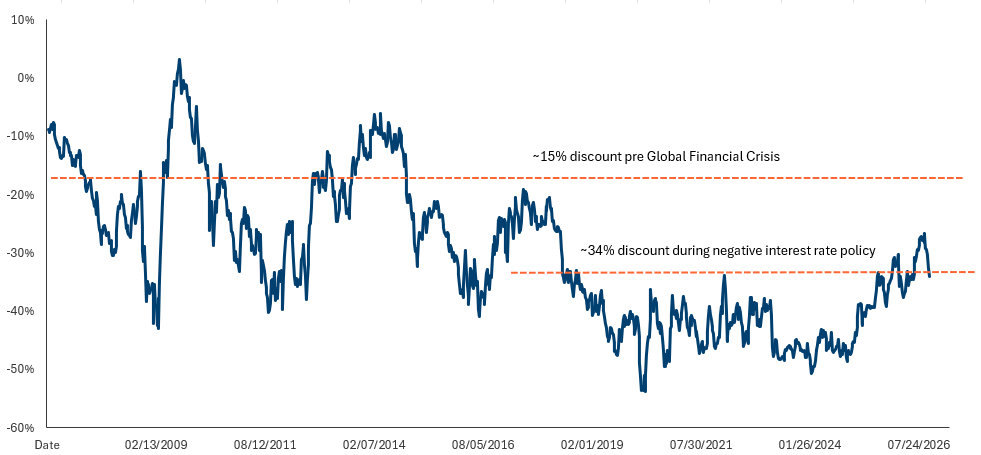 |
| Past performance is not indicative or a guarantee of future results. Source: Polar Capital and Bloomberg, October 2026. SX7E Index (EURO STOXX banks) relative 1 Yr Forward P/E vs SXXE Index (EURO STOXX). |
Earnings revisions for banks are among the strongest of any European sector. Feedback from the conference season was reassuring. On revenues, management teams highlighted that higher interest rates remain supportive, as lower-yielding hedges and securities mature and are reinvested at higher yields, while the pass-through of higher rates to savers has remained lower than expected.
Loan growth remains robust, with evidence that the capital expenditure (capex) cycle is broadening out from AI and has not been derailed by rates staying higher than anticipated. Areas of strength include Central and Eastern Europe, periphery Europe, and UK corporate. Greece is the standout, with Alpha Bank citing EU recovery funds, defence, and energy investment as drivers of lending already under way, and Bank of Cyprus having hit its full-year loan growth target of 5% by the first half. Other areas of revenue growth included wealth fee income for HSBC and Standard Chartered. Other banks noted the structural growth opportunity from reforms to national savings and pensions in Ireland, Greece and Germany.
As with the banks, insurers are increasingly looking to use their robust balance sheets for value-creating M&A
Banks reported benign asset quality, with few signs of credit deterioration, although with the caveat that higher oil prices will have an impact on some borrowers. Concerns about private credit exposure have reduced since the start of the year, with managements highlighting low levels of absolute exposure. Surplus capital is being returned via dividends or share buybacks or used for mergers and acquisitions (M&A). Examples of the latter include UniCredit-Commerzbank, BAWAG-PTSB, and Erste-Santander Bank Polska, while Italian consolidation continues through multiple combinations around Intesa Sanpaolo’s offer for Monte dei Paschi.
We have slightly changed our mix of European banks by increasing our exposure to ING Groep (ING), the Netherlands' largest bank. ING is more sensitive to longer-term interest rates, whereas the periphery is more sensitive to short-term rates. Not unlike the UK banks, ING is benefiting from its 'replicating portfolio', where redeeming securities are reinvested into new government bonds at longer maturities, providing a medium-term tailwind for earnings. We also expect recent moves higher in bond yields to be positive for earnings, although we expect the benefit will feed through more slowly than for banks in Southern Europe, where we retain holdings across Italy, Spain and Greece.
Insurance
Meta Platforms’ release of its AI agent Muse in September triggered share price weakness for several insurers. However, management teams at a recent conference broadly rejected the idea that AI agents will significantly impact insurance distribution. For example, UK car insurer Admiral’s CEO pointed out that the UK is already around 90% intermediated by price comparison websites, so Muse and similar tools add little for consumers. Italian insurer Generali’s CEO called disintermediation “basically impossible” and favours human agents supported by AI. Based on our management meetings, the risk of AI disruption seems to have been overstated.
In general, the tone from meetings was that commercial insurance pricing is softening but not soft. Property insurance pricing is weakening, casualty is acceptable and specialty is firmer, but new business is harder to win because supply of capital is abundant. There has been a meaningful improvement in the regulatory environment, particularly for US insurers. In Europe, the Solvency II regulatory regime is being reviewed, and a number of insurers, such as AXA, expect a positive benefit. While the outlook for regulation in certain countries remains nuanced, the general direction of travel is positive.
As with the banks, insurers are increasingly looking to use their robust balance sheets for value-creating M&A as illustrated by the acquisition of Beazley by Zurich Insurance Group earlier in the year. We have a number of holdings in the portfolio that are seen as susceptible to bid due to their size notwithstanding each is also held for its own standalone merits.
Diversified financials
We had good meetings with, among other, Nordnet and Avanza, Swedish savings platforms, and Euronext, the pan-European exchange which operates the French, Dutch, Italian and Belgian equity markets, among others. But counterintuitively, despite the pervasive negative narrative around the private equity and private credit industry, our meetings with Ares Management, Bridgepoint and ICG were very positive. All have seen decent growth in assets under management and flows this year. Ares Management and ICG pointed out that fund raising is not the constraint on their private credit businesses, notwithstanding outflows that the industry has seen in wealth management products. In particular, the ability to deploy capital and find investments that meet the necessary risk and return thresholds is the biggest constraint on growth.
Bridgepoint was the most upbeat meeting we had, especially on the opportunity in its infrastructure business, Energy Capital Partners. The meeting focused on the attractive supply and demand dynamics for electricity generation in the US and why there has been a big jump in demand for new gas power stations, driven in part by the build out of AI data centres. As a result of that demand, its around $275m investment, in 2024, for a majority stake in ProEnergy, which makes and services gas turbines is now expected to see a significant increase in its valuation with it being reported that it is considering an IPO (a stock market listing) at a valuation of between $40bn and $50bn. If that were to happen it would lead to a significant boost to Bridgepoint’s earnings.
Outlook
The financials sector has lagged wider equity markets year to date. While it is not alone in doing so, with the technology sector significantly outperforming over this period, the fundamentals remain solid as evidenced by earnings and so we remain positive on the outlook notwithstanding shorter-term volatility. If AI continues to power economic growth, we see the sector remaining a beneficiary of that growth, whether it is banks seeing stronger corporate loan growth for capex or increased equity and debt capital markets activity, asset and wealth management businesses from higher equity markets and so on across exchanges, consumer finance companies and the other parts of the sector.